Unleashing the Power of Equity: A Game-Changer for Homeowners Considering Selling
Lisa Mailhot | August 15, 2023
Buyers

Lisa Mailhot | August 15, 2023
Buyers
As a homeowner, the decision to put your house on the market might be causing you some hesitation. Perhaps the thought of taking on a higher mortgage rate for your next property is holding you back. If this is your primary concern, familiarizing yourself with the concept of equity could be the key to boosting your confidence and facilitating your transition.
Equity essentially signifies the existing value of your home minus the outstanding loan balance. Notably, this equity has been experiencing a rapid expansion, exceeding expectations in recent times.
During the past few years, the real estate market has witnessed a substantial surge in property prices, leading to a substantial increase in your equity within a relatively short period. Despite a gradual return to market equilibrium, the discrepancy between available homes for sale and eager buyers remains, fueling a resurgence in prices. In the words of Rob Barber, CEO of ATTOM, a prominent property data provider:
“Equity levels were high even during the recent downturn, and now they are going back up and better than ever.”
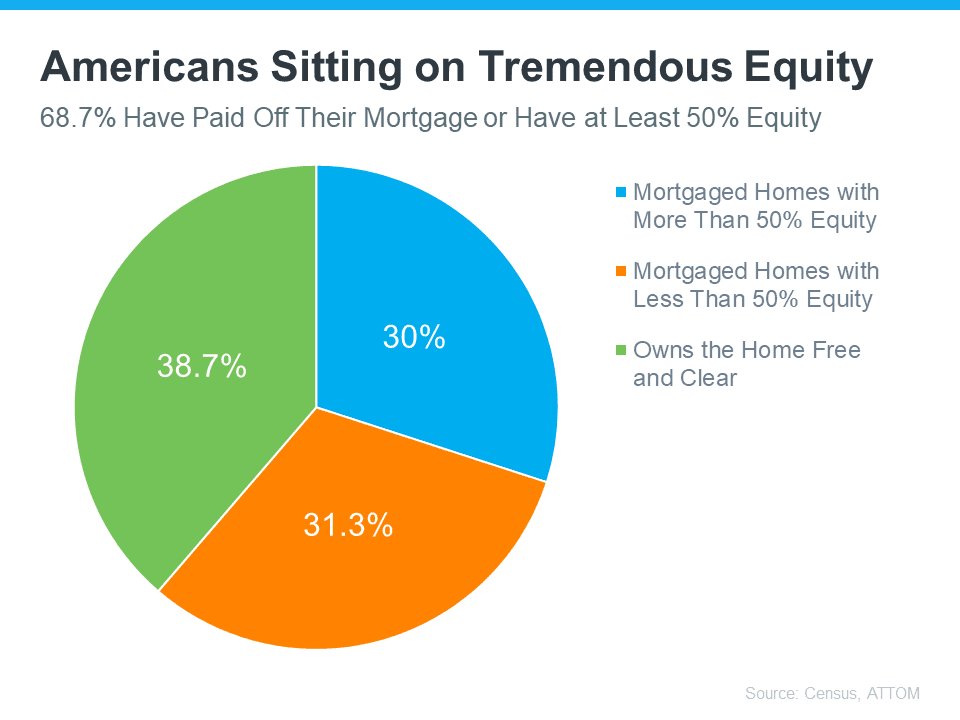
In today's landscape of affordability challenges, accrued equity can indeed be a game-changing asset during your relocation. Here's the rationale. According to data derived from ATTOM and the Census, a significant majority (approximately 68.7%) of homeowners have either fully repaid their mortgages or possess at least 50% equity (illustrated in the chart below):
This statistic implies that roughly 70% of homeowners currently enjoy a substantial equity position.
Upon selling your current residence, you can channel your equity to facilitate your subsequent purchase. It may potentially cover a significant portion, if not all, of your forthcoming down payment. In some cases, it might even grant you the capability to make a notably larger down payment, thereby reducing your financing needs. Furthermore, if your tenure in your existing home spans several years, you might have accumulated adequate equity to facilitate an all-cash payment. This scenario would allow you to bypass borrowing altogether, eliminating concerns about prevailing mortgage rates.
The most effective means of gauging your equity is to engage a reliable real estate agent and request a Professional Equity Assessment Report (PEAR).
If you're considering a transition, the accumulated equity can have a significant influence. Let's link up to determine the exact extent of your home's equity and explore ways to harness it for your upcoming investment.

A new bipartisan bill may let first-time buyers pull up to $35,000 from a 529 plan tax free for a down payment. Here's what it means for Orange County.

A bipartisan bill could double the capital gains tax exclusion on home sales, freeing up Orange County inventory and rewarding long-term homeowners.

The 2026 summer housing market has slowed nationwide, giving buyers more time and leverage. Here's what it means for Orange County movers.

Fannie Mae and Freddie Mac's new condo underwriting rules could slow approvals and raise costs. Here's what Orange County buyers and sellers need to know.

A new federal housing law cuts red tape and boosts construction. Here is what it means for Orange County buyers, sellers, and investors.

Homebuyer affordability dropped for a fifth month in a row. Here's what it means for Orange County buyers and sellers and how to plan your next move.

New Redfin data reveals weather beats affordability as the top reason Americans relocate, and Orange County has exactly what movers are chasing.

Pending home sales rose as mortgage rates briefly dipped. Here's what this summer housing market shift means for Orange County buyers and sellers.

Fed Governor Waller wants less forward guidance on rates. Here's what that means for Orange County buyers and sellers trying to time the market.
Let's find a time that suits you best to chat about your goals, show you how we work, and figure out how we can help you the most
Get In Touch With Lisa

Broker Associate
949-877-7087
124 Tustin Ave Suite 200, Newport Beach, CA 92663